

Sydney International Strategy Forum 2025: Conference summary
Session 6 | Can allies shape US strategy?
Key points
- Allies have influenced US policy in the past and can do so in the future.
- Allies can shape US strategy by employing their deep understanding of US culture and interests, defining goals and leveraging human networks.
- The time to leverage the soft power that Australia and Japan have built over decades of cooperation with the United States is now, as the window of opportunity to influence US policy and assume a regional leadership role is closing.
https://www.youtube.com/watch?v=gkPbieUos-0
In his keynote address, General David Berger (Ret’d) argued that allies can shape US strategy, and that the time has come for them to do so. He noted that Australia and Japan are currently in a strong position to step into a leadership role in the security relationship with the United States and urged them to seize the opportunity while it was still available.
General Berger pointed to a variety of historical instances in which pressure exerted by allies compelled the United States to change policy “for the right reasons.” In particular relevance to the alliance, General Berger spoke about the 2012 stationing of a rotational force of 250 US Marines in Darwin, Australia, which has since expanded to a permanent force of 2,500 along with equipment and aircraft. The move was a reversal from initial US policy that regarded Australia as too far removed from the core of Indo-Pacific strategy, and came as the result of consistent, targeted pressure from Australia.
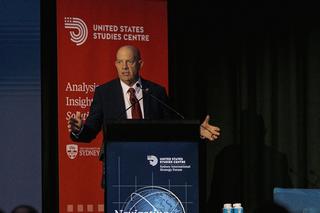
General Berger urged allies to act decisively to steer the relationship. He emphasised that the influence that Australia and Japan have over the United States is not a resource that should be held in reserve until time of crisis nor a finite resource that can be depleted through overuse.
General Berger laid out a variety of tools that allies should employ to use this agency to steer US policy. He noted that allies have a highly advanced understanding of US culture and interests, which gives them leverage. He also advised allies to remain focused on long-term goals, rather than concentrating on short-term disruption. General Berger recommended that allies find a way to make concessions not appear to be a net loss to the United States, and to consider the benefit to the United States when advocating for a new policy. Finally, he recommended that allies find new places to inject policy proposals within “human networks” in the United States rather than relying on traditional official channels.
To conclude, General Berger urged allies to act decisively to steer the relationship. He emphasised that the influence that Australia and Japan have over the United States is not a resource that should be held in reserve until time of crisis nor a finite resource that can be depleted through overuse. Rather, it is a capability that should be drawn on immediately, while the window of opportunity to influence United States policy is still open.
Key points
- Australia and Japan should “go big” in their approach to the United States, being ambitious in shaping the larger agenda rather than seeking to make themselves smaller targets.
- Australia and Japan will grow closer because of decreased trust in US institutions and interests, but in ways that complement US strategy.
- In response to US burden-sharing concerns, Australia and Japan should act promptly to demonstrate capabilities and shape the agenda in line with their own interests.
https://www.youtube.com/watch?v=4aKJAkKVcEQ
As allies navigate the second Trump administration, the panellists agreed that the time had come to “go big.” General David Berger (Ret’d) emphasised that a “small ball” strategy was likely only to lose allies their seat at the table, while failing to guarantee any insulation from collateral damage. Instead, General Berger and The Hon Arthur Sinodinos AO urged allies to approach President Trump with a confident, focused strategy. Importantly, allies should frame relationships in terms of the benefits that they can offer to the United States, as discussed by Sinodinos and Takashi Yamashita. Dr Kori Schake stressed that allies must crystallise a single unified policy when framing these benefits, strengthening their message by presenting it as a united front.
Panellists then turned to a discussion of decreased trust in the United States, which has hit record lows in polling of Australian and Japanese publics. Sinodinos and Representative Yamashita pointed out that even amid faltering trust in the United States, trust in the alliance had increased in both Australia and Japan, particularly as perceptions of China had decreased. However, given the United States’ unpredictability, both allies acknowledged a need to work more closely together, irrespective of US participation. Sinodinos explained that a tightening in the Australia-Japan relationship reflected a desire for greater optionality, in which allies sought alternatives beyond the United States that nevertheless remained consistent with US goals. Panellists agreed that a closer alignment of Japan and Australia stood to benefit the United States, as all three nations shared a common interest in a free and open Indo-Pacific. General Berger specifically noted that a stronger network of alliances across the region would create advantages in sustaining military logistics.
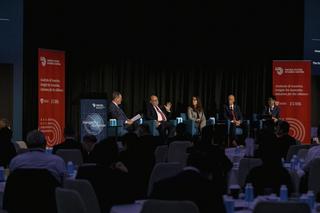
With US interests in the region often difficult to discern, Sinodinos argued that the onus rested on allies to influence perceptions of the value they could bring to Washington.
Finally, panellists discussed the question of what ‘America First’ meant for burden-sharing in the Indo-Pacific. With US interests in the region often difficult to discern, Sinodinos argued that the onus rested on allies to influence perceptions of the value they could bring to Washington. Specifically, Dr Schake viewed disruption as an opportunity for allies to demonstrate their leadership, coalition-building and military capabilities. She said that allies should assume the greatest risk and responsibility over outcomes in the Indo-Pacific, approaching the United States to act in a supporting capacity. By acting early and decisively to assume a leadership role, allies then gain the opportunity to steer policy in ways that benefit their own interests.